SaaS SEO Services Best for Organic Growth

Software-as-a-Service companies operate in one of the most competitive digital markets. Many SaaS businesses rely heavily on paid advertising to acquire customers, but paid channels can become increasingly expensive over time. As cost-per-click rises and competition grows, customer acquisition costs often increase, making it harder for SaaS companies to maintain profitable growth.
Organic search offers a more sustainable path. When implemented properly, SaaS SEO services help software companies attract users who are actively searching for solutions, tools, or platforms related to their product. Unlike paid ads that stop generating traffic when budgets run out, SEO continues to deliver long-term visibility and qualified traffic.
SaaS SEO services focus on improving search visibility for product pages, feature pages, and educational content. By targeting the right search queries and optimizing technical performance, SaaS businesses can consistently attract potential customers throughout the entire buyer journey.
WordPress Webers provides specialized SaaS SEO services designed to support scalable growth for software companies. Instead of relying on generic SEO tactics, the approach focuses on strategies that work specifically for SaaS platforms. This includes:
- Data-driven SEO research to identify high-intent keywords
- SaaS content strategies designed to educate and convert users
- Technical SEO improvements that support scalable product platforms
These SaaS SEO services help software companies increase visibility, attract qualified users, and convert traffic into product trials or subscriptions.
In this guide, you will learn:
- What SaaS SEO services are and how they work
- Why SEO is essential for SaaS companies looking for sustainable growth
- The key strategies involved in effective SaaS SEO services
- How WordPress Webers helps SaaS businesses build scalable organic growth
What Are SaaS SEO Services?
SaaS SEO services are specialized search engine optimization strategies designed to help software companies improve their visibility in search engines and attract users searching for digital tools or platforms.
These services include keyword research, technical SEO improvements, SaaS content marketing, product page optimization, and authority building through backlinks. The goal of SaaS SEO services is to increase organic traffic, attract qualified prospects, and support recurring user acquisition for SaaS products.
1. What can we expect from SaaS SEO Services
SaaS SEO Services are specialized search engine optimization strategies designed specifically for Software-as-a-Service companies. The goal of SaaS SEO Services is to help software products rank higher in search engines when potential customers search for solutions related to their problems. Instead of simply increasing website traffic, SaaS SEO Services focus on attracting users who are actively looking for software tools, platforms, or digital solutions.
Unlike many traditional marketing approaches, SaaS SEO Services aim to bring users into a long-term acquisition funnel. When implemented correctly, these services help SaaS companies build consistent organic visibility, attract qualified users, and convert them into trial signups or paying customers.
SaaS SEO Services usually involve several components working together, including keyword research, technical SEO improvements, product page optimization, content marketing, and link building. The strategy is built around understanding how software buyers search online and what type of information they need before making a purchase decision.
Difference Between SaaS SEO and Traditional SEO
While SEO fundamentals remain the same, SaaS SEO Services are different from traditional SEO in several important ways.
Traditional SEO often focuses on generating traffic for e-commerce stores, local businesses, or informational websites. In contrast, SaaS SEO Services are designed for digital products that require a longer decision-making process and more detailed product education.
Some key differences include:
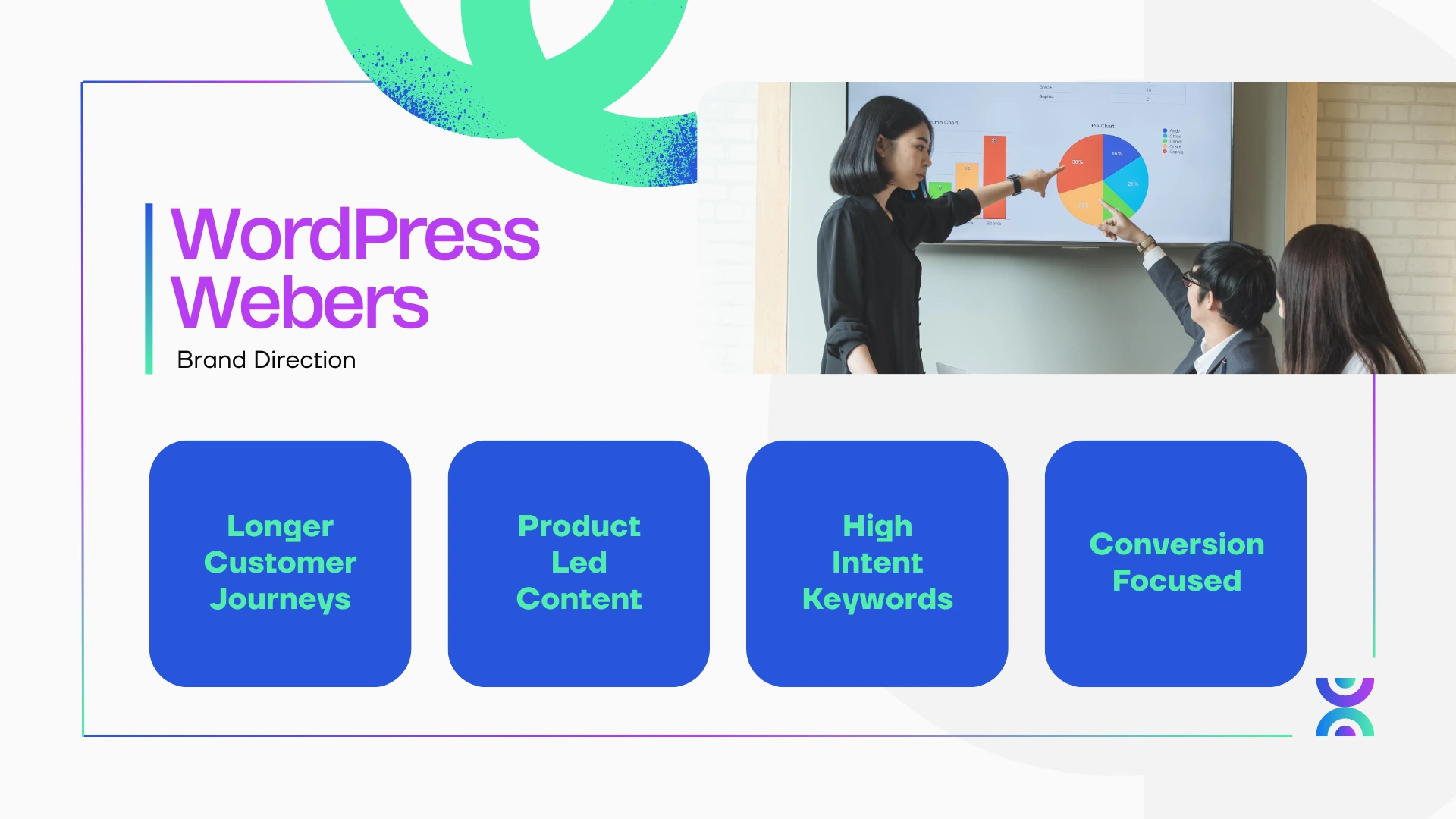
Longer customer journeys
SaaS buyers rarely purchase immediately. Most users research multiple tools, read comparisons, and evaluate product features before signing up.
Feature and solution based searches
Instead of searching for a simple product, users search for solutions to problems.
Examples include:
- CRM software for small businesses
- marketing automation platform
- project management tool for startups
Product-led content
SaaS SEO Services rely heavily on content that explains how the product works and how it solves user problems. Educational guides, product tutorials, and comparison articles are common.
Higher emphasis on intent
SaaS SEO Services prioritize keywords that indicate strong buying intent rather than just high traffic.
Because of these factors, SaaS SEO strategies focus more on conversion-driven traffic rather than raw page visits.
Key Characteristics of SaaS SEO Services
Several strategic elements make SaaS SEO Services unique.
Customer acquisition focus
Every page is optimized with the goal of attracting users who are likely to become customers. Instead of targeting broad informational keywords, SaaS SEO Services prioritize solution-oriented queries.
Longer sales cycles
Software buyers often take weeks or months to choose a platform. SEO content must guide users through each stage of the buying journey.
Typical stages include:
- Awareness of a problem
- Researching possible solutions
- Comparing different tools
- Signing up for a trial or demo
Product-led content
SaaS SEO Services use product-driven content that demonstrates real product value. This may include:
- feature breakdown pages
- use-case articles
- integration guides
- tutorials and walkthroughs
High-intent keyword targeting
High-intent keywords are searches where the user already knows they need a solution.
Examples include:
- best CRM software
- CRM automation tools
- sales CRM for startups
These types of searches often lead directly to product trials or demo requests.
Example of SaaS SEO in Action
To understand how SaaS SEO Services work in practice, consider a CRM software company.
A CRM platform may create optimized pages targeting search queries such as:
- CRM software for small businesses
- CRM automation tools
- best CRM software
Each page would be structured to answer the search intent behind the query.
For example:
Any page targeting “CRM software for small businesses” would explain how small teams can manage customer relationships, automate sales tasks, and track leads efficiently.
A page targeting “CRM automation tools” might focus on workflow automation, email sequences, and lead tracking.
Page targeting “best CRM software” could include product comparisons, feature highlights, and customer testimonials.
Through SEO, these pages are optimized with structured content, relevant keywords, strong internal linking, and technical SEO improvements. Over time, search engines recognize the site as a relevant source for CRM-related queries, allowing the pages to rank for competitive keywords.
As visibility grows, more users searching for CRM solutions discover the platform, visit the website, and sign up for trials or demos.
This is how SaaS SEO Services transform search demand into qualified product users.
2. Why SaaS Companies Need SEO
For most SaaS companies, growth depends on acquiring new users consistently while maintaining a sustainable customer acquisition cost. Paid advertising can deliver fast traffic, but it becomes expensive as competition increases. SaaS SEO Services provide a more scalable solution by building long-term organic visibility.
SEO allows software companies to reach users at the exact moment they are searching for solutions. Instead of interrupting users with advertisements, SaaS SEO Services place the product in front of users who are already looking for tools that solve their problem.
Over time, this creates a reliable channel for attracting qualified leads and generating new customers.
Benefits of SaaS SEO Services
One of the biggest advantages of SaaS SEO Services is the ability to generate continuous growth without relying entirely on paid campaigns.
Some of the most important benefits include:
Reduced dependence on paid advertising
Many SaaS companies initially rely heavily on platforms such as Google Ads or social media advertising to acquire customers. While effective, these channels require ongoing spending.
SaaS SEO Services help create a long-term traffic source that continues generating visitors even when advertising budgets are reduced.
Lower customer acquisition cost
Customer acquisition cost is a critical metric for SaaS businesses. Paid advertising often increases acquisition costs as competition grows.
By attracting users organically through search engines, SaaS SEO Services can significantly reduce the cost required to acquire each new customer.
Consistent flow of qualified leads
Search engine users often have a clear intent when they type a query. For example, someone searching for “best CRM software” is likely evaluating tools they plan to use.
By ranking for these high-intent queries, SaaS SEO Services bring highly relevant users to the website who are more likely to convert into trials or customers.
Improved brand visibility
When a SaaS platform consistently appears in search results for industry-related queries, it becomes more recognizable to potential users. This builds trust and authority within the market.
Over time, strong organic visibility can position the company as a leading solution within its category.
Support for product-led growth
Many SaaS businesses follow a product-led growth model where users explore the software through a free trial or freemium plan before upgrading.
SaaS SEO Services support this model by bringing users directly to product pages, feature explanations, and tutorials that demonstrate the value of the software.
SEO Impact on SaaS Revenue
SaaS SEO Services do more than generate traffic. They contribute directly to revenue growth by bringing users into the conversion funnel.
The typical process often looks like this:
Organic search traffic
→ user lands on an optimized page
→ user learns about the product
→ user signs up for a free trial or demo
→ user converts into a paying customer
Because SaaS products usually operate on recurring subscription models, each new customer contributes ongoing monthly or yearly revenue.
This means that even a single high-ranking page created through SaaS SEO Services can produce long-term value by continuously bringing in new users.
Over time, strong SEO performance supports two critical SaaS metrics:
Monthly Recurring Revenue (MRR)
Recurring revenue generated each month from active subscribers.
Annual Recurring Revenue (ARR)
Total subscription revenue generated over a year.
By consistently attracting qualified users who convert into subscribers, SaaS SEO Services help strengthen both MRR and ARR growth.
For many SaaS companies, SEO eventually becomes one of the most reliable channels for sustainable user acquisition and long-term revenue expansion.
3. How SaaS SEO Services Work (Step-by-Step Process)
SaaS businesses operate in highly competitive digital markets where potential customers actively search for software solutions online. SaaS SEO services are designed to help software companies appear in those search results and attract qualified users who are already looking for a solution.
Unlike general SEO, SaaS SEO services focus on product discovery, feature-based searches, and long buying cycles. A structured process ensures that the SEO strategy supports sustainable growth, user acquisition, and product visibility.
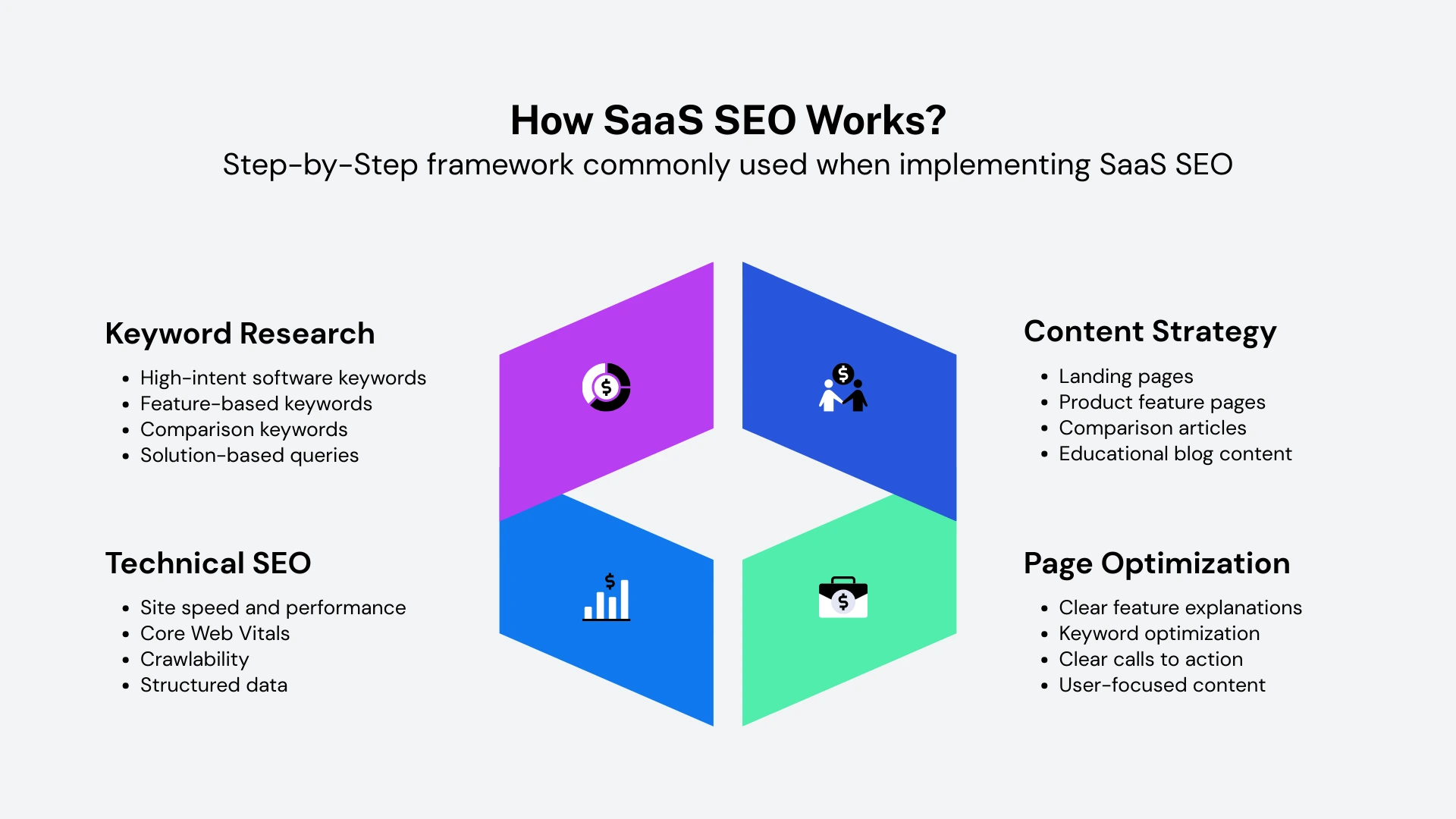
Below is the step-by-step framework commonly used when implementing SaaS SEO services for software platforms.
Step 1 – SaaS Keyword Research
Keyword research is the foundation of effective SaaS SEO services. The goal is to identify the exact search queries potential customers use when looking for software products or digital tools.
SaaS companies must target multiple types of keywords because users search in different ways depending on where they are in the buying journey.
Common keyword categories include:
- High-intent software keywords
These are direct product searches where users are ready to explore solutions. - Feature-based keywords
Users often search for specific capabilities rather than brand names. - Comparison keywords
These indicate strong buying intent as users evaluate alternatives. - Solution-based queries
These searches focus on solving a business problem.
Examples of SaaS keyword opportunities include:
- best project management software
- CRM tools for startups
- accounting software for freelancers
- email marketing automation tools
- HR software for small businesses
SaaS SEO services typically involve analyzing:
- search volume
- keyword difficulty
- user intent
- competitive landscape
The goal is to identify keywords that attract users who are most likely to start a trial, request a demo, or adopt the software.
Step 2 – SaaS Content Strategy
Content plays a major role in SaaS SEO services because software buyers usually conduct research before choosing a platform. A strong content strategy helps software companies educate potential users while positioning their product as the ideal solution.
Effective SaaS content strategies usually include a mix of pages designed for both discovery and conversion.
Key content assets often include:
Landing pages
Landing pages target important product categories or high-intent keywords. These pages explain the core solution, features, and benefits of the platform.
Product feature pages
Feature pages focus on specific capabilities of the software. Many users search for individual features such as automation, reporting tools, or integrations.
Comparison articles
Software comparison pages help users evaluate options before making a decision. These pages are highly valuable because they attract users close to purchasing.
Educational blog content
Blog content helps software companies build authority in their industry while targeting informational search queries.
Common SaaS content formats include:
- how-to guides explaining workflows or solutions
- software comparison articles
- product tutorials and onboarding guides
- industry best practice resources
A consistent content strategy helps SaaS SEO services generate long-term organic traffic while guiding users toward product adoption.
Step 3 – Technical SEO for SaaS Platforms
Technical optimization is another important component of SaaS SEO services. Search engines must be able to crawl, understand, and index the entire website efficiently.
SaaS platforms often have complex site structures, dynamic pages, and product documentation, which makes technical SEO especially important.
Key areas optimized during SaaS SEO services include:
Site speed and performance
Fast-loading websites improve user experience and support better search visibility. Page speed also affects conversion rates for product trials and demos.
Core Web Vitals
Search engines evaluate website performance using metrics such as loading speed, visual stability, and interactivity. Optimizing these signals is an important part of modern SaaS SEO services.
Crawlability
Search engines need clear access to important pages. Proper site architecture ensures that product pages, feature pages, and resources can be easily discovered and indexed.
Structured data
Structured data helps search engines better understand page content. It can also enhance search results with rich snippets that improve visibility.
Many SaaS websites also require scalable technical structures such as:
- organized URL hierarchies
- logical internal linking systems
- optimized documentation pages
Technical optimization ensures that SaaS SEO services support both search visibility and overall platform performance.
Step 4 – Product Page Optimization
Product pages are often the most important conversion pages on a SaaS website. SaaS SEO services focus on optimizing these pages so they can rank in search engines while also encouraging visitors to take action.
Strong product pages combine SEO optimization with clear user communication.
Key elements of product page optimization include:
Clear feature explanations
Users should quickly understand what the software does and how it solves their problem.
Keyword optimization
Important keywords should appear naturally within headings, descriptions, and supporting content.
Clear calls to action
SaaS platforms often use actions such as:
- start free trial
- book a demo
- create account
These calls to action should be visible and easy to follow.
User-focused content
Instead of simply listing features, product pages should explain real-world use cases and benefits.
When properly optimized, product pages become powerful assets within SaaS SEO services because they attract qualified users who are actively searching for solutions.
Step 5 – SaaS Link Building
Search engines evaluate website authority based partly on backlinks from other trusted websites. SaaS SEO services therefore include strategic link building to improve domain credibility and visibility.
Link building for SaaS companies often focuses on earning mentions and references from relevant industry sources.
Common link acquisition strategies include:
- industry publications that cover software products
- SaaS directories and software listing platforms
- guest articles on relevant blogs and publications
- digital PR campaigns featuring product insights
These backlinks signal to search engines that the software platform is credible and authoritative within its category.
Over time, consistent link building strengthens the overall effectiveness of SaaS SEO services and helps websites compete for competitive software-related keywords.
4. SaaS SEO Services Offered by WordPress Webers
SaaS companies require specialized SEO strategies because their growth depends on consistent user acquisition and product discovery. WordPress Webers provides SaaS SEO services designed to support software businesses at different stages of growth.
The approach focuses on combining technical optimization, content strategy, and search visibility to help SaaS platforms attract qualified users.
SaaS SEO Strategy Development
Every successful SEO copywriting services begins with a well-defined strategy. WordPress Webers develops custom SaaS SEO services based on the specific goals, audience, and market position of each software company.
The strategy process typically includes:
- detailed market analysis
- competitor research within the software category
- search demand analysis to identify growth opportunities
This research helps determine which search queries software buyers are using and how the website can capture that demand.
By aligning SEO efforts with product positioning and user intent, SaaS SEO services can generate consistent organic growth.
SaaS Technical SEO
Technical performance is essential for SaaS platforms because many software websites include dynamic pages, product documentation, and interactive dashboards.
WordPress Webers provides technical SaaS SEO services that focus on improving website performance and search engine accessibility.
Key technical improvements include:
- website performance optimization for faster loading times
- identifying and fixing crawl errors
- improving indexing to ensure important pages appear in search results
- optimizing Core Web Vitals for better user experience
These improvements allow search engines to understand the platform structure while also improving usability for potential customers.
SaaS Content Marketing
Content marketing plays a major role in SaaS SEO services because potential customers often research solutions before selecting a product.
WordPress Webers creates content that helps software companies connect with users at different stages of the buying journey.
The goal of SaaS content marketing is to:
- attract users searching for solutions
- educate readers about industry challenges
- guide visitors toward product adoption
Effective SaaS content often includes tutorials, product guides, and educational resources that help users understand how the software solves real problems.
Over time, consistent content creation builds topical authority and strengthens the impact of SaaS SEO services.
SaaS On-Page Optimization
On-page optimization ensures that each page communicates clearly with both search engines and users.
WordPress Webers performs detailed on-page improvements as part of its SaaS SEO services.
This includes:
- keyword optimization within page content and headings
- improving product page structure and readability
- implementing structured data to help search engines interpret content
These improvements help search engines better understand the purpose of each page while also improving the overall user experience.
SaaS Link Building
Authority is essential for competing in the software industry. WordPress Webers provides SaaS SEO services that focus on building high-quality backlinks from credible sources.
Link building efforts help SaaS platforms strengthen their search visibility and compete for important industry keywords.
Key objectives include:
- earning backlinks from relevant industry websites
- improving domain authority through credible references
- strengthening brand visibility within the SaaS ecosystem
Over time, these efforts help establish the software company as a trusted resource within its market.
Read more about
5. SaaS SEO vs Traditional SEO
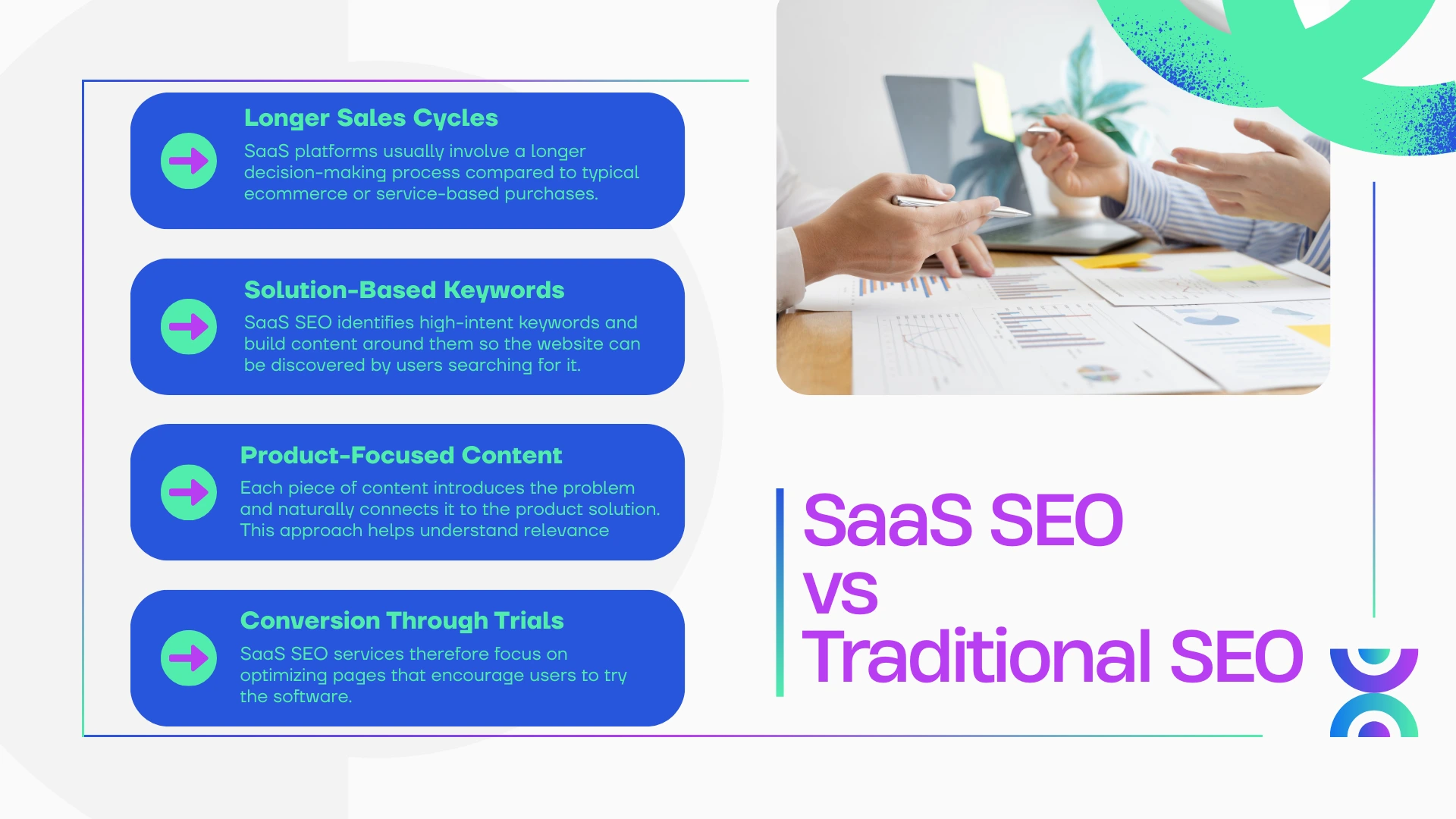
Many businesses assume that SEO strategies are the same across all industries. In reality, SaaS SEO services operate very differently from traditional SEO because software companies have unique growth models, longer decision cycles, and subscription-based revenue.
Traditional SEO typically focuses on driving traffic that converts quickly into a purchase. SaaS businesses, however, rely on education, product awareness, and nurturing users before they commit to a subscription. Because of this, SaaS SEO services must combine search optimization with product marketing, feature discovery, and customer education.
The main differences between SaaS SEO and traditional SEO can be seen across several key areas.
| Factor | SaaS SEO | Traditional SEO |
| Sales cycle | Longer | Shorter |
| Keywords | Solution based | General |
| Content | Product focused | Informational |
| Conversion | Free trial / demo | Purchase |
Longer Sales Cycles
SaaS platforms usually involve a longer decision-making process compared to typical ecommerce or service-based purchases. Businesses often evaluate multiple software tools before choosing one, which means users may visit several pages and consume different types of content before signing up.
SaaS SEO services focus on capturing users at different stages of this journey:
- Awareness stage: educational content about industry problems
- Consideration stage: comparisons between tools or platforms
- Decision stage: product pages and feature explanations
This layered approach allows SaaS companies to guide potential users from discovery to product adoption.
Solution-Based Keywords
Another major difference lies in keyword targeting. Traditional SEO campaigns often focus on broad search queries or product names. SaaS SEO services, however, prioritize solution-based search intent.
People searching for software are usually trying to solve a specific problem. Instead of searching for generic terms, they use queries such as:
- project management software for remote teams
- CRM software for startups
- automated accounting tools
SaaS SEO services identify these high-intent keywords and build content around them so the website appears when users actively look for software solutions.
Product-Focused Content
Content in SaaS SEO strategies is closely connected to product features and use cases. Instead of publishing generic informational blogs, SaaS SEO services often build content clusters that revolve around the product’s capabilities.
For example, a SaaS company offering marketing automation tools may create content about:
- email automation workflows
- lead nurturing software
- marketing analytics dashboards
Each piece of content introduces the problem and naturally connects it to the product solution. This approach helps search engines understand the relevance of the software platform while also educating potential users.
Conversion Through Trials and Demos
In traditional SEO campaigns, the final conversion is usually a direct purchase. SaaS businesses operate differently. The first conversion step is often a free trial, product demo, or account signup.
SaaS SEO services therefore focus on optimizing pages that encourage users to try the software. These pages typically include:
- product feature breakdowns
- case studies and testimonials
- clear calls to action for free trials or demos
This strategy allows SaaS companies to build a pipeline of potential users who can later convert into paying customers.
Overall, SaaS SEO services are designed to support long-term user acquisition rather than immediate sales. By targeting solution-focused keywords and creating product-driven content, SaaS companies can attract users who are actively searching for tools to solve their business challenges.
6. Tools Used in SaaS SEO
Executing successful SaaS SEO services requires more than just writing optimized content. Modern SEO strategies rely on specialized tools that help analyze search demand, monitor website performance, and identify growth opportunities.
These tools allow SEO teams to collect data about search trends, competitor strategies, and technical website issues. By combining insights from multiple platforms, SaaS SEO services can develop data-driven strategies that improve visibility and drive consistent organic traffic.
Below are some of the most widely used tools that support SaaS SEO services.

Ahrefs
Ahrefs is widely used for keyword research and backlink analysis. SaaS SEO services rely on this platform to identify valuable search opportunities and understand how competitors are performing in search results.
Key ways Ahrefs supports SaaS SEO services include:
- discovering high-intent SaaS keywords
- analyzing backlinks from competing software websites
- identifying content gaps in the market
- tracking keyword ranking performance
These insights help SaaS companies target the right search queries and strengthen their authority within their industry.
SEMrush
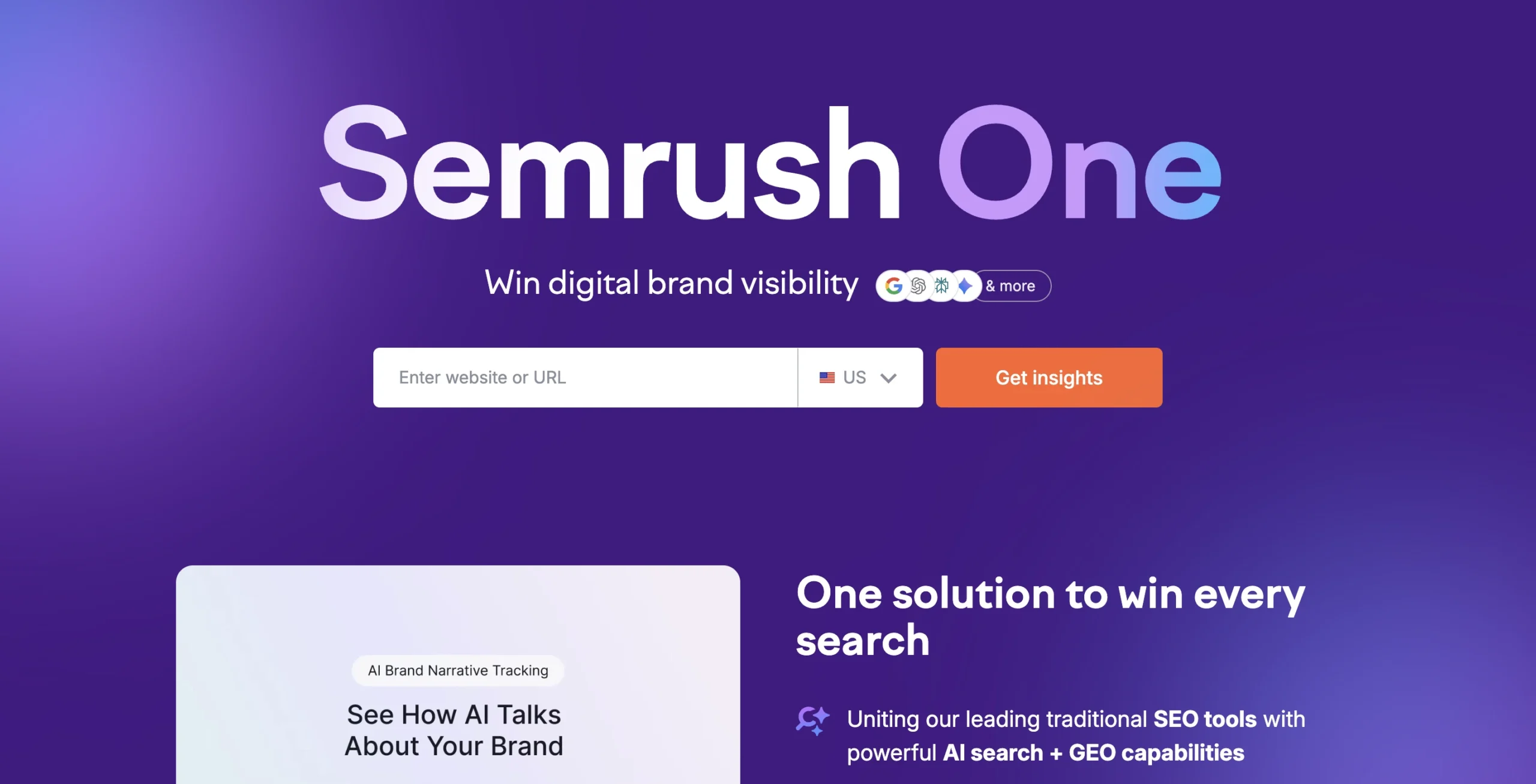
SEMrush provides a broad range of tools for competitive analysis, keyword tracking, and content optimization. Many SaaS SEO services use it to monitor how software companies compete for search visibility.
With SEMrush, SEO teams can:
- analyze competitor keyword strategies
- track keyword rankings over time
- discover new content opportunities
- evaluate domain authority and traffic trends
This information helps SaaS businesses identify areas where they can outperform competitors in organic search.
Google Search Console
Google Search Console is one of the most important tools used in SaaS SEO services because it provides direct insights from Google’s search data.
It allows website owners to monitor how their pages perform in search results and identify technical issues that may affect rankings.
Some important insights available through Search Console include:
- search queries bringing traffic to the site
- click-through rates from search results
- indexing issues preventing pages from appearing in search
- mobile usability problems
By regularly analyzing this data, SaaS SEO services can improve page performance and ensure that search engines can properly crawl and index the website.

Surfer SEO
Surfer SEO focuses on content optimization. It analyzes top-ranking pages for a specific keyword and provides recommendations on how to structure content so it aligns with search intent.
Within SaaS SEO services, Surfer SEO helps teams:
- optimize headings and content structure
- improve keyword placement
- ensure the content covers relevant topics
- align pages with search engine expectations
By following these insights, SaaS companies can create content that is both user-friendly and optimized for search engines.
Combining these tools allows SaaS SEO services to approach search optimization from multiple angles. Keyword research tools reveal demand, technical tools ensure website performance, and content optimization platforms help produce pages that satisfy both users and search engines.
7. Common SaaS SEO Mistakes
Many SaaS companies invest in SEO but fail to see consistent growth because their strategy is not aligned with how software buyers actually search online. SaaS SEO Services require a structured approach that combines product-focused content, technical optimization, and strong search intent alignment. Without these elements, even well-written content can struggle to generate traffic or convert users.
Below are some of the most common mistakes companies make when implementing SaaS SEO Services.
Targeting Only High-Volume Keywords
Many SaaS teams focus only on keywords with high monthly search volume. While these keywords appear attractive, they are usually extremely competitive and dominated by well-established websites with strong domain authority.
For example, trying to rank for a broad keyword like “CRM software” can be very difficult for a newer SaaS product. Instead of relying solely on broad terms, SaaS SEO Services should include a balanced keyword strategy.
A stronger approach includes targeting:
- Feature-based keywords
- Long-tail keywords with clear search intent
- Solution-focused queries
Examples include phrases such as “CRM software for small consulting firms” or “CRM with automated lead tracking.” These keywords may have lower search volume, but they often bring visitors who are closer to making a purchase decision.
Ignoring Long-Tail Intent Keywords
Long-tail keywords are one of the most valuable assets in SaaS SEO Services because they reflect very specific user needs. Software buyers usually search for solutions to particular problems rather than generic product categories.
For example, instead of searching only for “project management software,” users might search for:
- project management software for remote teams
- project management tool with Gantt charts
- project management software for agencies
These queries signal clear intent and can drive more qualified traffic. A SaaS SEO Services strategy should prioritize identifying these keywords through search intent analysis and integrating them into product pages, blog content, and comparison articles.
Ignoring Product Pages
Another common mistake is focusing heavily on blog content while neglecting product pages. Educational articles can generate traffic, but they do not always convert visitors into users unless the product pages are optimized properly.
Product pages are critical in SaaS SEO Services because they serve as the main conversion points where users explore features, pricing, and benefits.
Effective product page optimization typically includes:
- Clear feature explanations
- Search-optimized headings and content
- Internal links from relevant blog posts
- Structured content that answers common user questions
When product pages are properly optimized, they can rank for high-intent keywords and drive free trial sign-ups or demo requests.
Poor Internal Linking
Internal linking plays a major role in how search engines understand the structure of a website. Unfortunately, many SaaS websites have weak internal linking, which makes it difficult for search engines to discover important pages.
SaaS SEO Services should include a clear internal linking strategy that connects related content throughout the site. This helps distribute authority across pages and improves crawlability.
A strong internal linking structure often includes:
- Linking blog posts to relevant product pages
- Connecting feature pages with related tutorials or guides
- Creating topic clusters that link multiple related articles together
Without these connections, valuable pages may remain buried within the site structure and struggle to rank in search results.
Weak Content Strategy
A weak or inconsistent content strategy is another reason SaaS SEO campaigns fail. Publishing random blog posts without a clear topical focus makes it difficult to build authority in a specific category.
Successful SaaS SEO Services rely on structured content planning that aligns with the product, the industry, and user search behavior.
An effective SaaS content strategy typically focuses on:
- Educational content explaining software solutions
- Product-focused articles highlighting key features
- Comparison pages that help users evaluate alternatives
- Tutorials and use cases showing real-world applications
When content consistently answers user questions and aligns with product functionality, it becomes much easier to build trust and attract qualified traffic.
Read More : AI SEO Tools Scale Agile Solutions
8. Expert SaaS SEO Growth Tips
Growing organic traffic in the SaaS industry requires more than basic SEO techniques. The most successful software companies rely on structured strategies that connect product features with real user search intent. SaaS SEO Services play a crucial role in implementing these strategies and ensuring that content, technical SEO, and keyword targeting work together to generate sustainable growth.
Below are several proven strategies that experienced SaaS SEO teams use to scale organic traffic.
Build Topical Authority
Search engines increasingly prioritize websites that demonstrate deep expertise in a specific topic area. Instead of publishing unrelated articles, SaaS companies benefit from building topical authority around the core problem their software solves.
SaaS SEO Services often use a cluster-based content model to achieve this. In this approach, a central pillar page targets a broad topic while multiple supporting articles cover related subtopics.
For example, a SaaS product in the project management category could build a content cluster around the main topic “project management software.” Supporting content could include:
- guides on project planning techniques
- tutorials on task tracking methods
- feature comparisons between project management tools
- productivity strategies for remote teams
By consistently publishing content within the same category, the website signals expertise and relevance to search engines, which improves the chances of ranking for competitive keywords.
Use Comparison Content
Comparison content is one of the most effective formats in SaaS SEO Services because it targets users who are already evaluating different software solutions.
When users search for comparisons between two products, they are often close to making a purchasing decision. Creating detailed comparison articles allows SaaS companies to capture this high-intent traffic.
Common examples include:
- Slack vs Microsoft Teams
- Notion vs Evernote
- Asana vs Trello
These pages typically include feature comparisons, pricing differences, use cases, and advantages for specific types of users. Well-structured comparison content can attract visitors who are actively comparing tools and looking for the best solution for their needs.
Focus on Feature-Based SEO
Another powerful growth strategy is feature-based SEO. Many software buyers search for specific capabilities rather than general product categories. This creates opportunities for SaaS companies to rank for highly targeted keywords.
SaaS SEO Services often identify important product features and build content around them. This approach connects the software’s capabilities directly with user search behavior.
For example, users may search for terms like:
- task automation software
- CRM with email integration
- time tracking software for freelancers
Instead of relying only on broad keywords, feature-based SEO allows SaaS companies to rank for very specific queries that reflect real product requirements.
When combined with well-optimized product pages and supporting blog content, feature-based SEO can significantly increase the number of qualified visitors arriving at a SaaS website.
These strategies demonstrate how SaaS SEO Services go beyond traditional SEO practices. By focusing on search intent, product relevance, and structured content planning, SaaS companies can create a sustainable organic growth channel that continues to generate users over time.
9. Future Trends in SaaS SEO
Search behavior and search engine technology are evolving quickly. SaaS companies that rely on organic growth need to adapt their strategies to remain visible in search results. Modern SaaS SEO services must account for new developments in artificial intelligence, search experience changes, and product-driven content strategies.
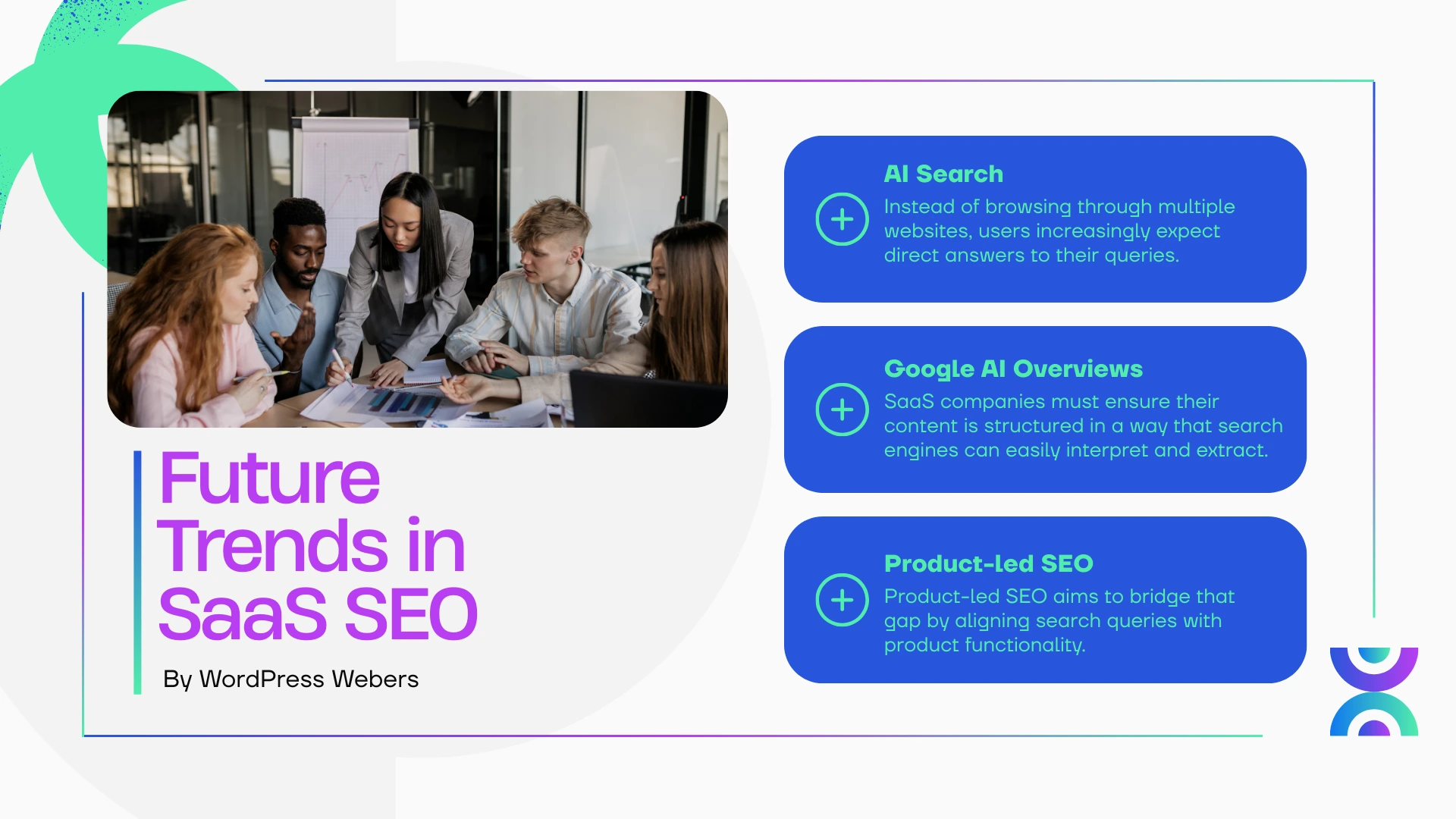
Below are some of the most important trends shaping the future of SaaS SEO.
AI Search
Artificial intelligence is transforming how users interact with search engines. Instead of browsing through multiple websites, users increasingly expect direct answers to their queries. AI-powered search systems analyze content, understand intent, and summarize information before presenting results.
For SaaS companies, this shift means that traditional keyword-focused strategies are no longer enough. SaaS SEO services now need to optimize content for semantic search, user intent, and contextual relevance.
Some important changes driven by AI search include:
- Search engines understanding the context of a query instead of just matching keywords
- Increased importance of topic authority and comprehensive content
- Greater reliance on natural language queries and conversational search
- AI systems summarizing content from multiple sources
To stay competitive, SaaS websites must produce content that clearly explains their software solutions, product capabilities, and real use cases. SaaS SEO services often focus on creating detailed educational resources, feature pages, and solution guides that answer user questions in depth.
For example, a SaaS company offering project management software may create pages that explain:
- how project management software improves team collaboration
- features of task management platforms
- comparisons between different project management tools
This type of content helps search engines understand the software product while also making it easier for users to evaluate solutions.
Google AI Overviews
Another major development affecting SaaS SEO services is the introduction of AI-powered summaries within search results. These summaries aim to provide quick answers to user queries by compiling information from multiple websites.
Because of this shift, SaaS companies must ensure their content is structured in a way that search engines can easily interpret and extract.
Important optimization practices include:
- Writing clear and concise explanations
- Structuring content with logical headings
- Providing direct answers to common user questions
- Using schema markup where relevant
- Maintaining strong internal linking across related content
Content that is well organized and informative has a higher chance of being referenced by AI-powered search features.
For SaaS companies, this means that product pages, feature descriptions, and solution-based guides should be written with clarity and depth. Instead of focusing only on promotional messaging, SaaS SEO services often prioritize content that educates potential users.
Examples of effective SaaS content include:
- software feature explanations
- tutorials on using the product
- comparison guides between competing tools
- implementation guides for specific industries
These resources help search engines understand the value of the software while also assisting potential customers in making informed decisions.
Product-Led SEO
One of the most significant developments in SaaS marketing is the rise of product-led SEO. This approach focuses on creating content and landing pages that directly connect search traffic with the software product.
Traditional content marketing often attracts informational traffic that does not always convert into users. Product-led SEO aims to bridge that gap by aligning search queries with product functionality.
Modern SaaS SEO services increasingly prioritize:
- feature-focused landing pages
- use-case pages targeting specific problems
- solution pages for different industries
- comparison pages against competing tools
For example, a SaaS company offering CRM software might create pages targeting queries such as:
- CRM software for startups
- CRM tools for sales teams
- customer relationship management automation tools
Each of these pages highlights how the product solves a specific business problem.
Product-led SEO also emphasizes helping users experience the product quickly. This often includes:
- interactive product demos
- free trial sign-up pages
- clear onboarding guides
- educational product documentation
When implemented effectively, product-led SEO connects organic traffic directly to the product experience. This reduces friction in the customer journey and improves conversion rates.
SaaS SEO services that integrate product education, content marketing, and search optimization are better positioned to drive meaningful growth for software companies.
10. Conclusion
Organic search remains one of the most reliable and scalable growth channels for SaaS businesses. Unlike paid advertising, which stops generating traffic when budgets are paused, SEO builds long-term visibility that continues to attract potential users.
SaaS SEO services help software companies reach the right audience at the moment they are searching for solutions. By targeting relevant keywords, creating valuable content, and optimizing technical performance, SaaS companies can steadily grow their organic presence.
The benefits of SaaS SEO include:
- consistent organic traffic from search engines
- reduced customer acquisition costs over time
- stronger brand authority within the software industry
- improved lead generation and product adoption
However, achieving these results requires more than basic SEO practices. Successful SaaS SEO depends on a structured approach that combines several elements:
- detailed keyword research based on search intent
- product-focused content strategies
- technical optimization for performance and crawlability
- strong internal linking and website architecture
- ongoing content updates to remain relevant in search results
This is where specialized SaaS SEO services become valuable. SaaS companies often operate in highly competitive markets where effective search visibility can directly impact user growth and recurring revenue.
WordPress Webers provides SaaS SEO services designed to help software companies build sustainable organic growth. By combining technical SEO expertise, strategic content development, and data-driven optimization, WordPress Webers helps SaaS businesses improve search rankings, attract qualified users, and expand their digital presence.
With the right SaaS SEO services and a long-term strategy, software companies can turn organic search into a powerful driver of user acquisition and business growth.
11. Grow Your SaaS Business with WordPress Webers

Software companies operate in highly competitive digital environments where visibility directly impacts growth. Organic search remains one of the most sustainable ways to attract qualified users who are actively searching for software solutions. This is where SaaS SEO services play an important role.
WordPress Webers provides structured SaaS SEO services designed specifically for software companies that want to scale their organic presence. Instead of relying solely on paid acquisition channels, SaaS businesses can use search optimization to build long-term traffic pipelines that consistently generate product trials, demo requests, and recurring users.
A strong SaaS SEO strategy focuses on improving search visibility across product pages, feature pages, comparison pages, and educational content. WordPress Webers approaches SaaS SEO services with a data-driven framework that combines technical optimization, content strategy, and authority building.
Through SaaS SEO, WordPress Webers helps software companies:
- Improve rankings for high-intent software keywords
- Attract users actively searching for SaaS solutions
- Increase qualified traffic to product and landing pages
- Build topical authority within specific software categories
- Generate consistent organic leads and product signups
Unlike short-term marketing tactics, SaaS SEO focuses on sustainable growth. Once high-intent keywords begin ranking, they continue to generate traffic and potential customers over time.
WordPress Webers works with SaaS companies to develop customized SEO strategies that align with their product offerings, target audience, and market demand. This includes keyword research, technical SEO improvements, content planning, and authority building that strengthens long-term search performance.
If your SaaS platform aims to increase organic traffic, attract qualified users, and reduce customer acquisition costs, implementing structured SaaS SEO services can make a measurable difference.
Contact WordPress Webers today to discuss a tailored SaaS SEO strategy designed to support the long-term growth of your software business.
12. FAQs – SaaS SEO Services
i. What are SaaS SEO services?
SaaS SEO services are specialized search engine optimization strategies designed for software companies that operate on subscription models. These services focus on improving search rankings for software-related queries, increasing organic traffic, and attracting users who are actively looking for digital solutions. SaaS SEO services typically include keyword research, technical SEO, content creation, and link building.
ii. How long does SaaS SEO take to show results?
Most SaaS SEO services begin showing measurable improvements within three to six months. However, the timeline can vary depending on factors such as domain authority, industry competition, and the current technical health of the website. In competitive software markets, consistent optimization and content development are essential for long-term growth.
iii. Why is SEO important for SaaS companies?
SEO helps SaaS companies attract users who are already searching for solutions to specific problems. Instead of relying entirely on paid advertising, SaaS SEO services allow companies to generate sustainable organic traffic. This can significantly reduce customer acquisition costs while creating a steady flow of potential users.
iv. What makes SaaS SEO different from regular SEO?
SaaS SEO services differ from traditional SEO because they focus on software-related search behavior, long buying cycles, and product-driven content. Many SaaS users research tools, compare alternatives, and explore features before signing up. Effective SaaS SEO services address these search patterns through targeted landing pages, comparison articles, and educational content.
v. How does SaaS SEO generate leads?
SaaS SEO services generate leads by helping software websites rank for high-intent search queries. These queries are often used by individuals actively looking for software tools, such as feature-based searches or comparison searches. When a SaaS platform ranks for these queries, it attracts visitors who are more likely to sign up for trials or request demos.
vi. What types of keywords are important for SaaS SEO?
SaaS SEO services typically target several types of keywords, including:
- Solution-based keywords related to specific software categories
- Feature-focused keywords describing software capabilities
- Comparison keywords that evaluate different tools
- Educational queries that explain software use cases
A balanced keyword strategy allows SaaS companies to capture users at different stages of the buying journey.
vii. Do SaaS companies need technical SEO?
Technical SEO plays a critical role in SaaS SEO services. SaaS websites often contain complex structures, multiple landing pages, and dynamic content. Technical optimization ensures that search engines can properly crawl, index, and understand the website. Key areas include page speed, internal linking, structured data, and mobile performance.
viii. How does content marketing support SaaS SEO?
Content marketing is a major component of SaaS SEO services. High-quality content helps software companies explain product features, answer user questions, and demonstrate expertise within their industry. Blogs, product tutorials, comparison articles, and guides can all attract organic traffic while supporting product adoption.
ix. Can SaaS SEO reduce marketing costs?
Over time, SaaS SEO services can significantly reduce reliance on paid advertising. While paid campaigns stop generating traffic once the budget is paused, organic search traffic continues as long as pages maintain their rankings. This makes SEO a cost-effective acquisition channel for SaaS companies looking to scale sustainably.
x. How do SaaS SEO services support long-term growth?
SaaS SEO services support long-term growth by building a strong search presence across multiple software-related topics. As content clusters expand and authority grows, the website begins ranking for a wider range of queries. This increases visibility, attracts consistent traffic, and helps software companies capture more potential customers through organic search.